Draft Foreign Investment Rules 2026: What Boards and Company Secretaries Need to Know
What the RBI’s Draft Foreign Investment Rules 2026 mean for boards and company secretaries: FDI and FPI thresholds, the compliance onus, and the comment window.
By Sandhya Aggarwal · Managing Partner, Eraqus Advisors · 8 min read
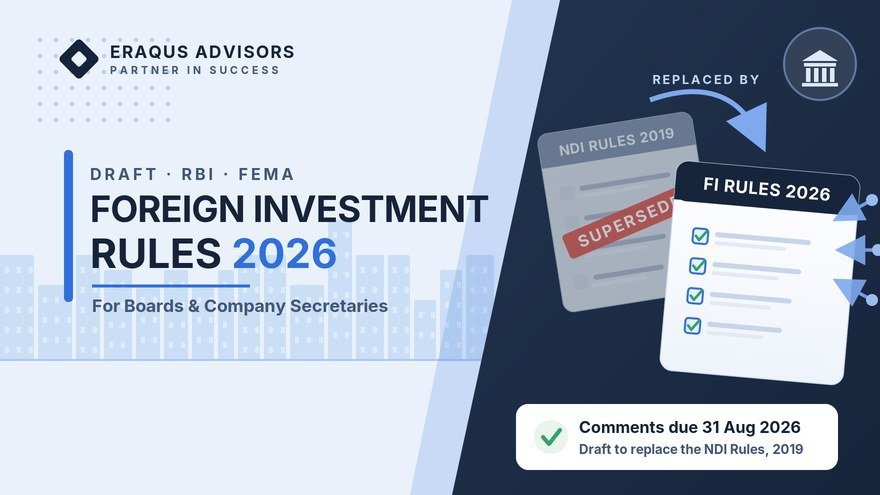
The Reserve Bank of India has released the draft Foreign Exchange Management (Foreign Investment) Rules, 2026, and it is not a routine amendment. If finalised, it would replace the Foreign Exchange Management (Non-Debt Instruments) Rules, 2019 in their entirety, resetting the rulebook that governs how foreign capital enters and moves within Indian companies. For boards and company secretaries, this is the kind of structural change that is worth reading early, while the text is still a draft and comments are still open.
This article sets out what has actually happened, what the draft proposes to change, where the compliance responsibility sits, and the practical steps a board or a company secretary can take now. It is written for governance and compliance readers rather than as a clause-by-clause legal commentary, and it flags throughout that the Rules are a draft and not yet in force.
What Has Actually Happened
On 21 July 2026, the RBI published a draft Notification proposing the Foreign Exchange Management (Foreign Investment) Rules, 2026, through Press Release No. 2026-2027/726. The draft would supersede the Non-Debt Instruments (NDI) Rules, 2019 completely, except for things already done or omitted before the supersession. The exercise follows a Union Budget 2026-27 announcement of a comprehensive review of the NDI Rules, after which a committee constituted by the Central Government made the recommendations underlying this draft.
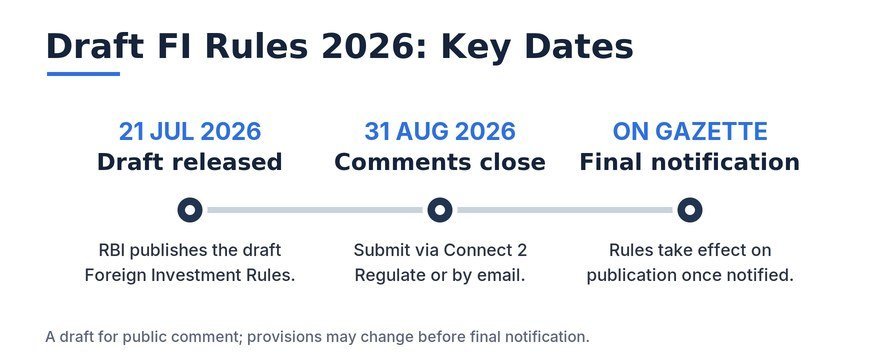
The draft at a glance: released 21 July 2026, proposes to replace the NDI Rules 2019, comments open until 31 August 2026.
Crucially, this is a draft for public comment, not a notified law. Comments are due by 31 August 2026, submitted through the RBI Connect 2 Regulate facility or by email with the subject line Feedback on Draft Foreign Investment Rules. The final Rules, once notified by the Ministry of Finance in the Official Gazette, would take effect on publication.
Why a Full Rewrite, Not an Amendment
The draft is best understood as a structural reset rather than an incremental change. The explicit supersession language, the Budget mandate, and the dedicated review committee all point to a deliberate rationalisation of the framework. The RBI press release identifies four salient features of the proposed Rules:
- A simplified and principle-based framework, with rationalised provisions and harmonised definitions to reduce regulatory complexity
- Alignment with the FDI policy, through a clearer separation of procedural FEMA provisions from policy and sector-specific requirements
- Enhanced ease of doing business, through streamlined procedures and greater operational flexibility
- A future-ready framework, with investor-neutral and investee-neutral provisions, while preserving necessary safeguards
What Counts as Foreign Investment Now
Two definitional points matter most for classification. First, the draft retains the familiar threshold: foreign investment of 10 percent or more in the equity of a company or LLP is Foreign Direct Investment (FDI), while less than 10 percent is foreign portfolio investment (FPI). Second, the range of entities that can receive foreign investment is set out expressly.
| Concept | What the draft says |
|---|---|
| FDI | Foreign investment of 10 percent or more in equity |
| Foreign portfolio investment | Foreign investment of less than 10 percent in equity |
| Eligible investee entity | Companies, LLPs, SEBI-registered investment vehicles (REITs, InvITs, AIFs, Venture Capital Funds, and mutual funds or ETFs investing over 50 percent in equity), and registered partnership firms or proprietary concerns |
| Not covered | Investment in a financial institution set up in an IFSC, as defined under the IFSCA Act, 2019 |
A practical consequence is that portfolio investment which crosses the 10 percent line on a recognised stock exchange may be reclassified as FDI, subject to the applicable FDI conditions. Boards should know which side of that line their foreign holders sit on, and whether any holder is close to crossing it.
Foreign Controlled Entity: Ownership and Control
The draft carries the concept of a foreign controlled entity (FCE), meaning a resident company, LLP, or investment vehicle owned or controlled by a person resident outside India. Rather than fixing a single threshold for FCE status, the draft generally defers to the ownership and control provisions stipulated by the relevant sectoral regulator, and where none exist, to the entity’s own governing law, such as the Companies Act, 2013 for companies. The 50 percent ownership and 10 percent voting-rights tests that appear in the draft are used mainly to decide whether indirect foreign investment counts as foreign investment, rather than to fix FCE status. This is a nuanced area, and it is exactly the kind of definition that deserves close reading during the comment period.
Who Bears the Compliance Onus
For governance readers, this is the heart of the matter. The draft places the onus of compliance jointly on the foreign investor and the eligible investee entity, or on the transferor and transferee, as applicable in a given transaction. In other words, the Indian company receiving foreign investment carries direct responsibility for compliance, not merely the investor. That responsibility is a board and company secretary concern: it touches how investments are approved, documented, priced, and reported.
RBI or DPIIT: Who to Approach
The draft draws a clearer line between the two authorities. The RBI administers the Rules and can issue regulations, directions, and clarifications on their implementation, while the power to interpret the FDI policy itself rests with the Department for Promotion of Industry and Internal Trade (DPIIT). For a company secretary, this affects a very practical question: whether a query is procedural, and therefore for the RBI, or a matter of policy interpretation, and therefore for DPIIT. Tracking whether the final Rules retain this split is worthwhile, because it changes who to write to.
International Listing, Codified
The draft consolidates the regime for direct listing of Indian companies’ equity on international stock exchanges into a single, detailed Annexure. Eligibility, pricing, voting rights, and the limited events in which shares can be transferred back to residents are now set out in one place, rather than scattered across separate scheme documents. For any company weighing an overseas listing route, this consolidation should make diligence easier to run.
What Boards and Company Secretaries Should Do Now
- Map existing foreign investment structures against the draft’s eligible investee entity and FCE definitions to spot any classification change
- Review current FDI and FPI holdings against the retained 10 percent threshold and the restated reclassification mechanics
- Study the Annexure on international listing closely if an overseas listing is in view
- Assess pledge, gift, and swap-based investment arrangements against the specific conditions in the draft
- Note who bears the compliance onus, and align internal approval and reporting processes accordingly
- Prepare and submit comments by 31 August 2026, treating the window as a chance to seek clarity before provisions become binding
- Monitor the Ministry of Finance Gazette for the final notification, since the Rules would take effect on publication
The Comment Window Is a Governance Opportunity
Because the Rules are still a draft, the comment period is not just a formality. It is a rare opportunity for companies and their advisors to seek clarity on ambiguous provisions, particularly the definitions of ownership, control, and foreign controlled entity, before they harden into law. Firms with active inbound investment structures should begin gap-testing their arrangements now rather than waiting for the final notification.
Frequently Asked Questions
What are the Draft Foreign Investment Rules 2026?
A draft framework released by the RBI on 21 July 2026 that proposes to replace the FEMA Non-Debt Instruments Rules, 2019 in full with a simplified, principle-based regime. It is a draft, not yet in force.
When is the comment deadline?
Public comments are due by 31 August 2026, through the RBI Connect 2 Regulate facility or by email with the subject Feedback on Draft Foreign Investment Rules.
How do the draft rules define FDI and FPI?
Foreign investment of 10 percent or more in equity is FDI, and less than 10 percent is foreign portfolio investment. Portfolio investment that crosses 10 percent may be reclassified as FDI.
Who is responsible for compliance?
The draft places the onus jointly on the foreign investor and the Indian investee entity, or on the transferor and transferee, which makes board and company secretary oversight important.
Do the draft rules apply to GIFT City or IFSC entities?
The draft rules do not apply to investment in a financial institution set up in an IFSC, as defined under the IFSCA Act, 2019.
Conclusion
The draft Foreign Investment Rules, 2026 propose the most significant reorganisation of India’s foreign investment rulebook since 2019. For boards and company secretaries, the immediate task is not to wait for the final text, but to understand how their existing structures would be classified, where the compliance responsibility sits, and which provisions are worth commenting on before the 31 August deadline.
Treated well, this is not only a compliance exercise but a chance to shape and prepare for the framework that will govern foreign investment for years to come.
This article is based on the RBI press release and the draft Notification, and expands on a note originally shared by our team on LinkedIn. View the original LinkedIn article.
Disclaimer: This article is for general informational purposes and describes a draft framework that is not yet in force. The Draft Foreign Investment Rules, 2026 may change before, or may not be, finally notified. Nothing here is legal or regulatory advice. Please confirm the current position with a qualified professional, or with Eraqus Advisors, before acting.
In this article
- What Has Actually Happened
- Why a Full Rewrite, Not an Amendment
- What Counts as Foreign Investment Now
- Foreign Controlled Entity: Ownership and Control
- Who Bears the Compliance Onus
- RBI or DPIIT: Who to Approach
- International Listing, Codified
- What Boards and Company Secretaries Should Do Now
- The Comment Window Is a Governance Opportunity
- Frequently Asked Questions
- Conclusion
About the author
Sandhya Aggarwal
Managing Partner, Eraqus Advisors
Fellow Company Secretary (FCS) with 18+ years of experience in corporate compliance, business setup, governance and regulatory advisory in India.
Need guidance on this?
Speak with our team about your requirement and the compliance that fits it.
More advisory insights

A practical guide to the FEMA Annual FLA Return: who must file, the July 15 deadline, GIFT City and IFSC reporting, and filing through the RBI FLAIR portal.

A practical guide to Form DPT-3: who must file, the June 30 deadline, deposits versus exempted deposits, the auditor certificate, and the penalties for late filing.

Practical strategies for conducting effective board meetings, agenda planning, board papers, quorum, minutes, resolutions, and disciplined post-meeting follow-up.
Discuss your requirement with our team
Tell us where your business stands and what you plan next, and we will explain the structure, documentation and compliance that fit your situation.